Beyond Manufacturing: How Automotive Logistics Empowers Asian Brands Globally
Asia has firmly established itself as the undisputed powerhouse of global automotive manufacturing. Led by China, the region produces over 21 million passenger cars annually, a staggering figure that dwarfs almost every other continent. While Japan and South Korea have long held the mantle of excellence, the scale of production today is so immense that Germany remains the only non-Asian nation capable of comparable output.
However, manufacturing prowess is only one side of the coin. As we move through 2026, the real catalyst for the global success of Asian brands is no longer just the assembly line; it is the evolution of sophisticated, technology-driven logistics networks. Advanced ports, digitalized supply chains, and end-to-end logistics solutions are the "hidden engines" empowering manufacturers to scale internationally. In this competitive landscape, companies like Transvoy Logistics are playing a pivotal role by bridging the gap between Asian factory floors and foreign showrooms.
The Foundation of Asia’s Automotive Dominance
- Supportive Policies: Government incentives, such as China’s strategic support for Electric Vehicle (EV) production and historical tax cuts, have accelerated growth beyond domestic needs, necessitating a global outlet.
- Integrated Supply Chains: Unlike many Western counterparts, Asian manufacturers benefit from highly localized component ecosystems. Having batteries, semiconductors, and steel produced within the same region creates a foundation of efficiency and value that is difficult to replicate.
- The Global Bridge: This internal strength must be matched by an external bridge. Without a robust exim logistics framework, even the best-produced car is a liability if it cannot reach its destination cost-effectively.
The New Logistics Imperative: More Than Just Moving Cars
We are witnessing a fundamental shift in the global automotive trade. As European manufacturing market share faces pressure and North American production remains largely focused on its own domestic demand, the world is looking to Asia to fill the gap. This has created a "logistics imperative" where basic transport is no longer enough.
Beyond Basic Ports
Modern manufacturers require more than a simple dock; they need vehicle handling terminals equipped with the latest technology. These terminals act as sophisticated hubs where finished vehicle logistics (FVL) meet digital precision.
The Power of Real-Time Data
In 2026, supply chain visibility is the ultimate currency. Manufacturers now demand real-time data to track their fleets across oceans. Knowing exactly when a shipment will arrive at a port allows for better coordination with local dealer networks, reducing "dwell time" and inventory costs. Transvoy Logistics addresses this need by providing integrated logistics solutions that prioritize data transparency and end-to-end control.
Case Study in Action: The Next-Generation Terminal Model
To understand how logistics empowers brands, we can look at the "Next-Gen Terminal" model currently being adopted by global leaders like DP World and regional experts like Transvoy Logistics.
A prime example is the Batangas terminal in the Philippines, which handles nearly 80% of the country’s finished vehicle imports. Its success is built on:
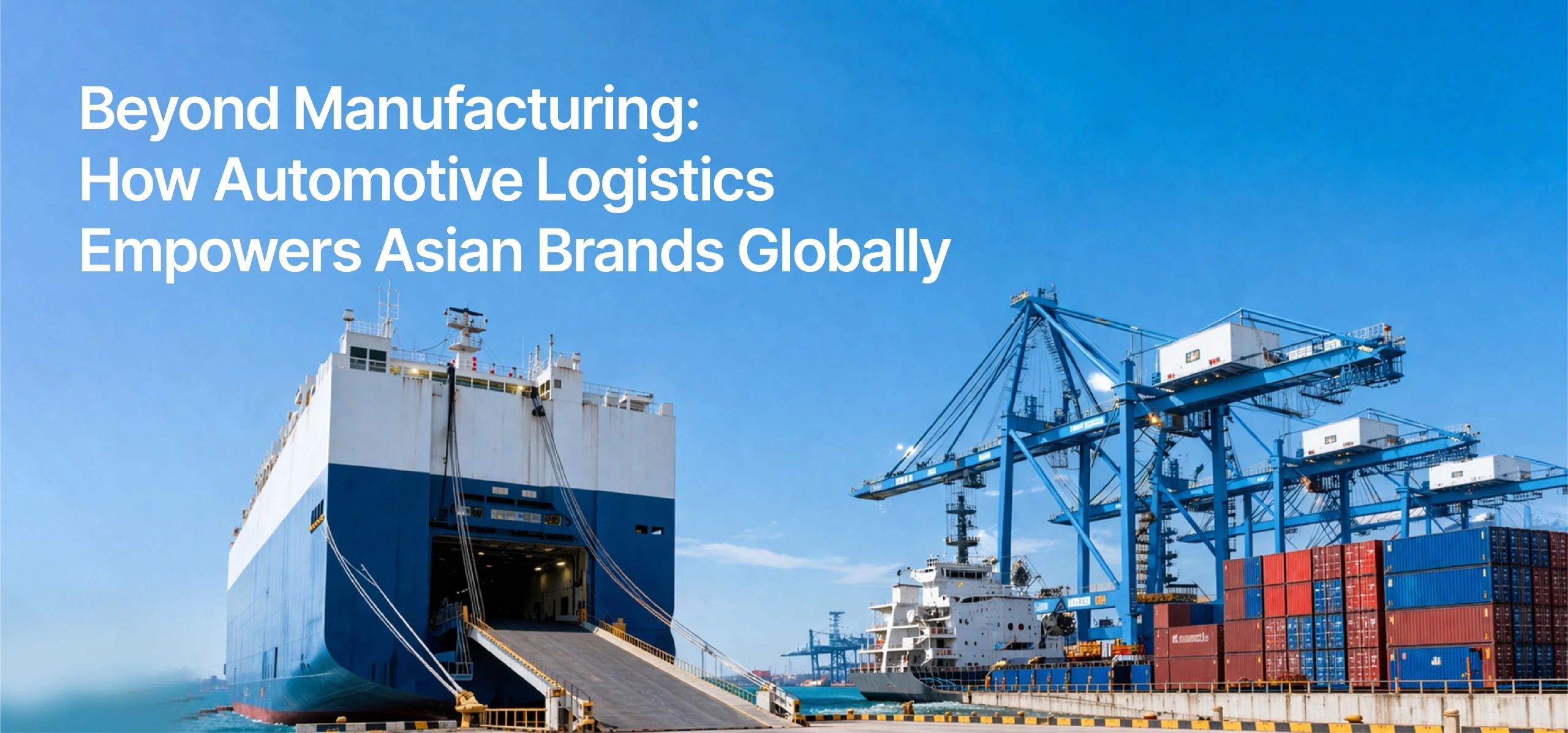
- Dedicated Ro-Ro (Roll-on/Roll-off) Berths: Specialized ramps allow vehicles to be driven directly onto and off ships, eliminating the need for slow and risky crane lifts.
- Multi-Level Parking: Urban port space is a premium; vertical storage ensures high-volume throughput.
- On-Site PDI (Pre-Delivery Inspection): By performing final inspections and value-added services at the port, manufacturers save time on land-side logistics.
- Terminal Operating Systems (TOS+): These digital brains synchronize every movement within the terminal, ensuring that no vehicle is lost or delayed.
When these advanced terminals form a network, they create a "network effect" that allows for seamless trade flow across continents.
Global Benefits for Asian Manufacturers
Choosing the right logistics partner—one that offers a global portfolio and exim transport expertise—provides three distinct advantages:
1. End-to-End Visibility and Control
By utilizing a "one-stop-shop" for end-to-end logistics, manufacturers gain total visibility. From the moment a car leaves a factory in India or China until it reaches a terminal in South America, every data point is captured.
2. Resilience and Redundancy
The modern trade environment is volatile. Having "twin ports" or alternate gateways (like Chile’s Puerto Central and Lirquen) provides a safety net. If one port faces congestion, a strategic partner like Transvoy Logistics can reroute cargo to ensure the supply chain remains unbroken.
3. Tapping into Emerging Markets
The rise of the Electric Vehicle (EV) supply chain has opened doors in Africa and South America. By replicating the high-tech Asian port model in these regions, manufacturers can enter new markets with the same reliability they enjoy at home.
Conclusion: The Strategic Advantage
In the race for global automotive dominance, the finish line isn't the factory gate, it’s the customer’s driveway. For Asian manufacturers, the transition from local heroes to global leaders depends on their ability to master the complexities of the global supply chain.
As a leading provider of logistics solutions, Transvoy Logistics understands that modern automotive trade requires a blend of heavy-duty infrastructure and light-speed technology. Whether it is ro-ro shipping, custom clearance, or specialized exim logistics, the right partner transforms a logistical challenge into a strategic advantage.