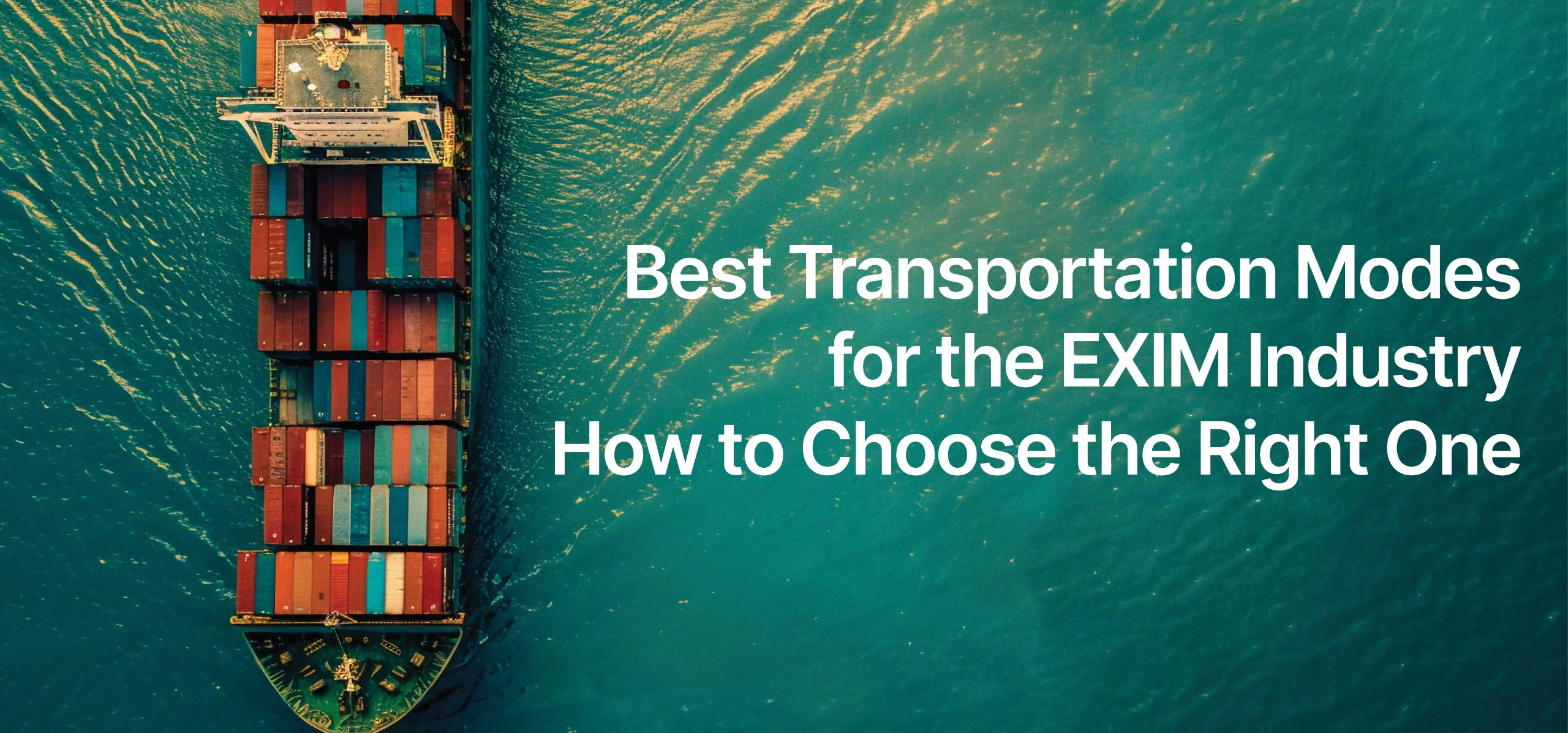
Best Transportation Modes for the EXIM Industry: How to Choose the Right One
Choosing the Best Transportation Method in the EXIM Industry
In the world of international trade, transportation is not just a logistical decision—it is a strategic one. The mode of transport you choose directly impacts cost, delivery timelines, cargo safety, customs clearance efficiency, and overall supply chain reliability. For businesses involved in EXIM industry logistics, even a small miscalculation can lead to delays, penalties, or loss of customer trust.
Choosing the best transportation method for EXIM requires balancing multiple factors such as shipment urgency, cargo nature, distance, budget, and regulatory requirements. Whether you are exporting pharmaceuticals, importing heavy machinery, or managing recurring international shipments, the right transport mode can significantly improve operational efficiency.
This guide will help you understand and compare the core transportation modes used in export-import business—air freight, ocean freight, and road transport—and build a clear framework to select the best transportation method for your EXIM needs, with insights from real-world logistics practices followed by experienced providers like Transvoy Logistics.
The Pillars of EXIM Transportation
In international freight transportation, there is no one-size-fits-all solution. Each mode serves a specific purpose depending on the shipment profile. Below is a simplified comparison to help you evaluate the best transportation method in EXIM.
| Ocean Freight / Sea Freight | Large volumes, non-urgent, long-distance shipments | Most cost-effective; high cargo capacity; ideal for heavy goods | Slow transit time; weather and port delays | Machinery, furniture, bulk commodities, manufactured goods |
| Air Freight | Time-sensitive, high-value, or perishable goods | Fastest mode; high security; reliable schedules | Most expensive; size and weight limits | Pharmaceuticals, electronics, fresh produce, auto parts |
| Road Freight | Short to medium distances, door-to-door delivery | Flexible routes; ideal for last-mile logistics | Traffic delays; higher risk of damage or theft | Consumer goods, industrial supplies, regional EXIM cargo |
Note: Rail transport is intentionally excluded as per Transvoy Logistics’ service offerings.
The Decision Matrix: Key Factors in Choosing the Right Freight Mode
Selecting the best transportation method for export-import business requires a structured evaluation of your shipment requirements. Below are the most critical factors businesses should consider.
1. Nature of Goods
The type of cargo plays a decisive role in choosing the transport mode.
- Perishable goods such as food items, pharmaceuticals, and temperature-sensitive products require speed and controlled environments—making air freight the fastest mode of transport for export.
- High-value or fragile goods benefit from air freight due to enhanced security and reduced handling.
- Heavy, oversized, or non-perishable cargo such as industrial equipment or machinery is best suited for sea freight, which is also the most cost-effective way to ship heavy machinery internationally.
Understanding how to ship perishable goods internationally or transport bulky cargo efficiently is key to minimizing losses and delays.
2. Cost vs Speed: The Core Trade-Off
One of the most common EXIM dilemmas is air freight vs sea freight cost.
- Air freight vs sea freight is essentially a choice between speed and affordability.
- Air freight ensures rapid delivery but comes at a premium.
- Ocean freight offers significant cost savings for large volumes, making it ideal for businesses looking to reduce shipping costs for small businesses without urgent delivery timelines.
- Road transport often serves as a middle ground for regional EXIM movements and inland distribution.
Choosing transport mode for import export decisions should always align with your business priorities.
3. Distance & Destination
Geography strongly influences the mode of transport for export-import business.
- Intercontinental shipments are best handled via international shipping methods such as ocean or air freight.
- Neighboring countries or domestic port connectivity rely heavily on road freight, especially for last-mile delivery.
- Ports, airports, and customs infrastructure at the destination also affect transit reliability.
Experienced freight forwarding partners like Transvoy Logistics assess destination-specific risks before recommending the optimal route.
4. Reliability & Risk Management
Reliability is critical in EXIM transportation services.
- Air freight offers the highest reliability with minimal cargo handling.
- Road transport advantages include flexibility but come with risks like traffic congestion, theft, and transit damage.
- Sea freight is susceptible to port congestion, weather disruptions, and longer dwell times.
A strong freight forwarding company mitigates these risks through route planning, insurance coordination, and real-time shipment tracking.
5. Sustainability Considerations: Environmental impact is becoming increasingly relevant in EXIM logistics.
- Sea freight generally has a lower carbon footprint per ton-mile compared to air freight.
- Businesses with ESG goals often balance sustainability with operational needs by optimizing shipment consolidation and transit planning.
Beyond the Basics: Advanced Logistics Strategies
Intermodal Shipping Solutions
Modern supply chains increasingly rely on intermodal shipping solutions, combining multiple transport modes for optimal efficiency.
For example:
- Ocean freight + road transport for port-to-door delivery
- Air freight + road transport for urgent shipments requiring final-mile connectivity
This approach enhances flexibility while maintaining cost and time efficiency across international freight forwarding services.
Also Read : Freight Forwarding Guide: Types, Process & Key Benefits How to Choose the Best Freight Forwarder: A Guide
The Role of Expert Logistics Partners
Navigating customs clearance logistics, carrier selection, documentation, and regulatory compliance can be complex—especially for growing businesses.
Freight Forwarders
A freight forwarder acts as a “travel agent for cargo,” managing:
- Carrier bookings
- Freight rate negotiations
- Documentation
- Customs coordination
- End-to-end shipment visibility
Understanding how to choose a freight forwarder is crucial for EXIM success.
Customs Clearance Expertise
Customs delays can disrupt entire supply chains. A reliable logistics company in India ensures:
- Accurate documentation
- HS code classification
- Regulatory compliance
- Faster cargo release
How Transvoy Logistics Simplifies EXIM Transportation
As a trusted freight forwarding partner, Transvoy Logistics delivers tailored EXIM transport and logistics solutions across:
- Air Freight Services for time-critical and high-value shipments
- Ocean Freight / Sea Freight for cost-effective international shipping
- Road Freight for domestic connectivity and last-mile delivery
- Customs Clearance Logistics
- End-to-end EXIM services and supply chain management
By combining global carrier networks with local expertise, Transvoy helps businesses choose the best transportation method for EXIM, reduce transit risks, and optimize shipping costs.
Conclusion: Making the Right Transportation Choice
Choosing the best transportation method in the EXIM industry is not about selecting the fastest or cheapest option—it’s about making a strategic decision based on cargo type, urgency, destination, cost sensitivity, and risk tolerance.
To summarize:
- Air freight is best for speed, perishables, and high-value goods
- Sea freight is ideal for bulk, heavy, and cost-sensitive shipments
- Road transport ensures flexibility and seamless door-to-door delivery
- Intermodal solutions offer the best of all worlds when planned correctly
For data-driven decisions and seamless execution, partnering with an experienced freight forwarding company like Transvoy Logistics ensures your EXIM shipments move efficiently, compliantly, and competitively in today’s dynamic global trade environment.