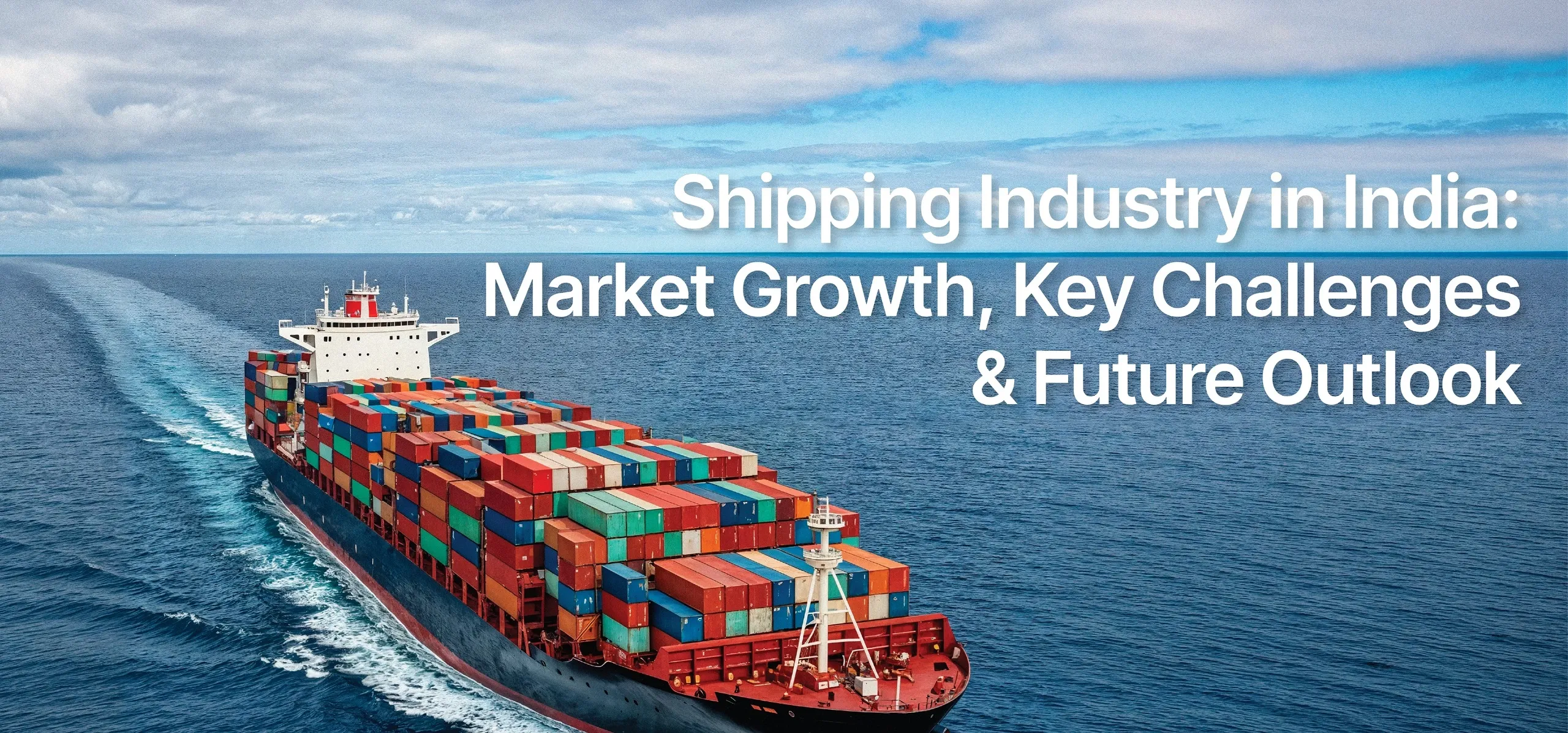
Shipping Industry in India: Market Growth, Key Challenges & Future Outlook
Setting the Maritime Stage
India’s shipping industry is the silent engine driving the nation’s trade ambitions. Nearly 95% of India’s trade by volume and 70% by value moves through the seas, making the Indian maritime sector indispensable to economic growth, global integration, and supply chain resilience.
Strategically positioned along major international trade routes, India boasts a 7,517 km coastline, 12 major ports, and over 200 non-major ports, giving it a natural advantage in international shipping, sea freight, ocean freight, coastal shipping, and EXIM trade logistics. From bulk commodities to high-value containerized cargo, ports in India are critical gateways connecting domestic markets with the global economy.
As India aspires to become a $5 trillion economy, the shipping industry in India is undergoing a transformative phase—driven by large-scale infrastructure investments, digital reforms, green shipping initiatives, and progressive policy frameworks such as the Sagarmala Programme, Maritime India Vision 2030, and Budget 2025 shipping initiatives.
This blog explores the current state, growth drivers, challenges, and future opportunities shaping India’s shipping and logistics ecosystem—while highlighting how integrated logistics partners like Transvoy Logistics are enabling seamless freight forwarding, customs clearance, and end-to-end supply chain solutions.
The Current State: India’s Maritime Infrastructure & Performance
Major Ports and Their Strategic Roles
India’s port ecosystem is anchored by 12 major ports governed by the central government and numerous state-managed ports:
- Deendayal Port (Kandla) – A major hub for crude oil, fertilizers, and EXIM trade logistics
- Mumbai Port – One of India’s oldest ports, supporting bulk and passenger cargo
- Jawaharlal Nehru Port Authority (JNPT) – India’s largest container port, handling over half of the nation’s container traffic
- Syama Prasad Mookerjee Port (Kolkata–Haldia) – Critical for eastern India’s trade and inland waterways
- Chennai, Visakhapatnam, Paradip, and Cochin Ports – Supporting industrial clusters and coastal shipping
These ports form the backbone of international freight forwarding services, facilitating customs clearance, freight services, and multimodal logistics.
Key Performance Indicators
- Cargo handled at Indian ports crossed 853.56 million metric tonnes (MMT) in FY25
- India’s EXIM trade continues to grow, supported by rising manufacturing, electronics, chemicals, and engineering exports
- Container traffic is increasing steadily, driven by e-commerce, retail, and FMCG supply chains
For logistics companies in India, these trends translate into rising demand for freight forwarding, ocean freight, air freight, and integrated logistics service.
India’s Global Standing
India’s maritime sector shows a mixed global position:
- 33% share in global ship recycling (Alang is among the world’s largest yards)
- 3rd largest ship recycling industry globally
- Only 0.07% share in global shipbuilding
- Around 1.2% share in global ship ownership
This gap between trade volumes and shipping capacity underscores why India remains heavily dependent on foreign shipping lines for over 85% of its EXIM trade—a challenge the government is now actively addressing.
Anchoring Growth: Key Government Initiatives and Investments
Sagarmala Programme: Port-Led Development
The Sagarmala Program is the cornerstone of India’s maritime transformation. With 279+ identified projects, it focuses on:
- Modernizing ports in India
- Enhancing port connectivity via road, rail, and inland waterways
- Promoting coastal shipping and port-linked industrialization
- Reducing logistics cost in India
Sagarmala has already improved turnaround times, boosted private participation, and strengthened freight forwarding and supply chain efficiency.
Maritime India Vision 2030
The Maritime India Vision 2030 (MIV 2030) outlines over 150 initiatives across:
- Port infrastructure expansion
- Shipbuilding in India
- Ship repair and recycling
- Maritime workforce development
- Digital and green shipping in India initiatives
MIV 2030 aims to position India as a global maritime hub, reducing reliance on foreign transshipment ports.
Budget 2025 Shipping Initiatives
The Union Budget 2025-26 gave a decisive push to the shipping industry in India:
- Maritime Development Fund (₹25,000 crore) for ship acquisition and infrastructure
- Infrastructure status for large vessels
- Extended customs duty exemptions on shipbuilding inputs
- Support for coastal shipping and inland waterways
These measures directly benefit Indian shipowners, logistics companies, and freight forwarding partners.
Shipbuilding & Financial Assistance
The Shipbuilding Financial Assistance Policy (SBFAP 2.0) and planned shipbuilding clusters aim to:
- Modernize shipyards
- Encourage private investment
- Strengthen domestic manufacturing under “Make in India.”
This is critical for reducing foreign dependency in international shipping and EXIM trade in India.
Legal Modernization: Indian Ports Bill 2025
The Indian Ports Bill, 2025, replacing the 1908 Act, introduces:
- Greater autonomy for ports
- Uniform regulatory frameworks
- Enhanced public-private participation
This reform improves ease of doing business for logistics companies in India, freight forwarders, and global shipping lines.
Digital & Green Transformation of Indian Shipping
One Nation One Port Process (ONOP)
The ONOP initiative standardizes documentation and processes across all major ports, significantly reducing:
- Paperwork
- Cargo dwell time
- Transaction costs
For freight forwarding companies like Transvoy Logistics, ONOP enables faster customs clearance and predictable supply chain planning.
Green Shipping India Initiatives
India is actively aligning with global decarbonization goals:
- Green Port Guidelines (2023)
- Green Tug Transition Programme (GTTP) for electric and LNG-powered tugs
- Green-digital corridors with countries like the Netherlands
- Shore power, solar energy, and electric cargo-handling equipment
These initiatives position India as an emerging leader in green shipping.
Navigating Headwinds: Challenges of the Indian Shipping Industry
Infrastructure & Transshipment Gaps
Despite progress, many Indian ports cannot handle Ultra-Large Container Vessels (ULCVs). As a result:
- Nearly 75% of India’s transshipment cargo is routed via Colombo, Singapore, and Dubai
- This increases logistics cost and transit time
The development of a transshipment port in India, such as Vizhinjam, is crucial.
Financial & Tax Disparities
Indian-flagged vessels face:
- 5% IGST, unlike foreign-flagged ships
- Higher financing costs
- Limited access to long-term capital
These factors reduce competitiveness in international shipping markets.
Aging Fleet & Technology Gaps
- A large portion of India’s fleet is over 20 years old
- Limited adoption of AI, IoT, and automation in shipbuilding and port operations
Modernization is essential to meet global efficiency and environmental standards.
Dependence on Foreign Shipping Lines
Over 85% of India’s EXIM trade is handled by foreign carriers, making the supply chain vulnerable to disruptions—as seen during the Red Sea crisis and pandemic-era congestion.
Charting the Course: Future Opportunities & Roadmap
Shipbuilding & Fleet Expansion
With infrastructure status, financial incentives, and policy clarity, India has an opportunity to:
- Expand domestic shipbuilding capacity
- Develop specialized vessels (LNG, green fuel, coastal vessels)
- Strengthen national shipping lines
Coastal Shipping & Inland Waterways
Currently, coastal shipping accounts for only 6% of domestic freight. Initiatives such as:
- Jalvahak Scheme
- Tonnage tax scheme for inland vessels
- Expanded inland waterways
It can significantly reduce logistics costs in India while cutting emissions.
Green Maritime Leadership
India is well-positioned to lead in:
- Green hydrogen shipping corridors
- LNG bunkering hubs
- Electric port operations
- Sustainable ship recycling industry
Technology, IFSC & Global Integration
- GIFT City IFSC is emerging as a hub for ship leasing, insurance, and maritime finance
- Adoption of AI, blockchain, and IoT will redefine port efficiency, freight forwarding, and supply chain visibility
Strategic & Economic Imperatives
A robust domestic shipping ecosystem is vital for:
- Strategic autonomy
- Trade resilience
- Lower freight costs
- Stronger EXIM trade logistics
Role of Transvoy Logistics in India’s Maritime Growth
As India’s shipping and logistics landscape evolves, Transvoy Logistics plays a critical role as a trusted freight forwarding partner. With expertise across:
- International freight forwarding services
- Ocean freight, air freight, and sea freight
- Customs clearance
- End-to-end supply chain and logistics solutions
Transvoy Logistics bridges the gap between policy-driven growth and on-ground execution—ensuring seamless cargo movement, compliance, and cost efficiency for Indian and global businesses alike.
Conclusion: Sailing Towards a Resilient Future
The shipping industry in India stands at a defining crossroads. With massive public investment, policy reforms like the Indian Ports Bill 2025, and ambitious visions such as Maritime India Vision 2030, the sector is primed for transformation.
However, unlocking its full potential requires addressing infrastructure gaps, financial disparities, technological modernization, and capacity constraints. Done right, India can emerge not just as a trade participant but as a global maritime leader.
For businesses navigating this dynamic ecosystem, partnering with experienced logistics companies like Transvoy Logistics ensures agility, resilience, and long-term success in an increasingly interconnected global supply chain.
India’s maritime journey has begun—and the horizon looks promising. Let’s move forward, together.